
Change in Industry
Our world is developing and changing so rapidly that it’s evident in every field. This is also evident in the industrial sector. Just recently, Industry 4.0 was being discussed, and suddenly, Industry 5.0 has begun to be discussed. So, what do these figures we’ve mentioned in the industrial sector mean? Where do we stand as a country? With the world changing so rapidly, are universities and even high schools offering training on this topic? Let’s try to answer these questions together.
According to the Turkish Language Association (TDK), the term “industry” means “industry.” Industry encompasses all processes and operations that process raw materials to meet human needs and ultimately transform them into currently used and usable goods and substances. All processes from raw materials to ready-to-consume products fall within the scope of industry.
INDUSTRY 1.0
The first industrial revolution emerged in the late 1700s and early 1800s with the use of water- and steam-powered machines. This development replaced physical labor with machine power. Daily life became much easier, and quality of life improved. As machines facilitated production, a significant increase in the number of products produced was observed. Large industrial facilities began to be established.
INDUSTRY 2.0
The second industrial revolution emerged in the late 1800s and early 1900s with the invention of electricity and the resulting mass production. Mass production, in particular, began in the automotive sector. Henry Ford established his first mass-produced assembly line, which began producing automobiles. This is known today as Industry 2.0 and still forms the cornerstone of manufacturing.
INDUSTRY 3.0
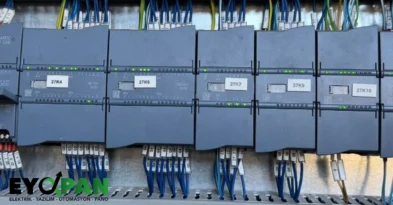
The third industrial revolution began in the mid-1900s with the digitalization of production processes and the establishment of automation systems. Automation is a concept that emerged primarily through the integration of various devices and interfaces, including mechanical, hydraulic, pneumatic, electrical, electronic, and computer systems. The revolutionary change in this revolution was the emergence of PLC systems.
INDUSTRY 4.0
The concept of Industry 4.0, supported by the German government, was first mentioned at the Hanover Fair in 2011. Industry 4.0 can be described as the implementation of many tasks performed by humans by artificial intelligence developed through technology. This era is also known as the “Internet of Things.” With Industry 4.0, system monitoring will become easier, efficiency will increase, costs will be significantly reduced, and the system will become more environmentally friendly. Certain professions will disappear, and different ones will emerge.
INDUSTRY 5.0
The term “Society 5.0” was first used in January 2016 by the Council of Ministers of the Japanese government’s Science, Technology and Innovation Council in the “Fifth Science and Technology Basic Plan.” Society 5.0 is defined as a “super-intelligent society” in which cyberspace and physical space (real society) are highly integrated. Japanese Prime Minister Shinzo Abe stated that they based this new concept on the belief that “Technology should be perceived by society as a helper, not a threat.”
In Industry 5.0, data collected from sensors located in industry, the environment, or our bodies is analyzed in cyberspace using artificial intelligence. Analysis results are transmitted to people in the physical realm in various ways. People, objects, and systems are all interconnected in the virtual realm, and optimal results that exceed human capabilities are fed back into the physical realm through artificial intelligence. With Industry 5.0, humanity will be able to work less and spend more time on itself. We will be warned in advance, even before we become ill, using sensors on our bodies.
Industrial facilities in our country have begun to invest in Industry 4.0, but the number of companies making investments is quite low. Many of our industrial facilities in our country are at the Industry 2.0 and Industry 3.0 levels. As a country, we must not miss the 4th Industrial Revolution. For industrial companies to grow, they must take a step towards INDUSTRY 4.0 as soon as possible. Authorized ministries, chambers, and universities must work together on this issue.
As a country, we must work towards Industry 5.0 and Society 5.0. Courses on these topics should be mandatory at universities, and the academic staff who will teach them must be thoroughly trained in these areas. In fact, these programs should be offered starting in vocational high schools. Unfortunately, our country still lacks this awareness, and I hope we will become aware of this awareness and begin working on it as soon as possible.